What the World Health Organization recommends
Adults over 65 follow the same basic guideline as younger adults, with one important addition: balance and strength. The WHO's 2020 guidelines recommend (WHO; summary table):
What | How much |
|---|---|
Moderate-intensity aerobic activity (such as easy cycling) | 150 to 300 minutes per week |
Or: vigorous-intensity aerobic activity | 75 to 150 minutes per week |
Muscle-strengthening activities, all major muscle groups | 2 or more days per week |
Extra for 65+: varied activity focused on balance and strength | 3 or more days per week, to prevent falls and stay independent |
The WHO adds that every bit of movement counts. According to the WHO, regular physical activity in older adults is linked to lower mortality, less cardiovascular disease, less type 2 diabetes, fewer falls, and better mental health, thinking skills and sleep (WHO fact sheet).
The same fact sheet reports that people who are insufficiently active have a 20 to 30% higher risk of death than people who are sufficiently active. Worldwide, 31% of adults fall short of the guideline, and activity levels drop after the age of 60 in both men and women.
And in Belgium? According to Sciensano's 2022-2023 Food Consumption Survey, 77% of women and 78% of men aged 65+ living at home are active for at least 150 minutes per week at moderate to vigorous intensity. These figures cover people living at home (Sciensano).
Living longer, and above all staying healthy for longer
Staying active means ageing well more often. The English ELSA study followed 3,454 healthy adults (average age 64) for eight years. "Healthy ageing" meant staying alive and free of major chronic disease, depressive symptoms, and physical or mental decline. People who stayed active throughout the study were 7.7 times more likely to age healthily than those who stayed inactive. People who only became active during the study were still 3.4 times more likely (Hamer et al., BJSM 2014). Any moment is a good moment to start.
Steps count, up to a point. A meta-analysis of 15 international studies, using steps measured by a device rather than self-reported, found that in adults over 60 the risk of death keeps falling as daily steps rise, up to about 6,000 to 8,000 steps a day. Beyond that, the benefit levels off (Paluch et al., Lancet Public Health 2022).
Generation 100: the honest picture. In Norway, 1,567 people aged 70 to 77 took part in a five-year randomised trial, the strongest type of research. One group did interval training twice a week (4 × 4 minutes at about 90% of maximum heart rate), a second group did 50 minutes of moderate training twice a week, and a control group was simply advised to follow the national activity guidelines (study protocol).
After five years, 4.7% of the control group had died. In the interval group this was 1.7 percentage points lower, a trend in favour of intensive training, though the difference was too small to be statistically significant. The researchers conclude that organised training added no measurable extra effect on mortality compared with people who already followed the guidelines (Stensvold et al., BMJ 2020). An important detail: 80% of participants were already moderately to highly active at the start, and the control group was very active too. That makes any difference hard to detect.
Staying independent and steady on your feet
For quality of life, being able to get around on your own may matter even more than the age you reach. This is where the evidence is strongest.
The LIFE study (United States). 1,635 people aged 70 to 89, who were inactive and already had mild limitations, were randomly assigned to an activity programme (mainly walking, plus strength, balance and flexibility exercises) or a health education programme. After an average of 2.6 years, 69.9% of the activity group could still comfortably walk 400 metres, compared with 64.5% of the education group. Put differently, their risk of major mobility loss was 18% lower (Pahor et al., JAMA 2014). Those who were weakest at the start benefited most (LIFE overview).
Steadier on your feet (Cochrane). A Cochrane review, the gold standard for summarising research, combined 108 randomised trials involving 23,407 people aged 60+ living at home in 25 countries. Exercise programmes reduced the number of falls by 23%, with high-certainty evidence. Programmes focused on balance and functional exercises worked best (Sherrington et al., Cochrane 2019).
Brain and memory
In 2024 the Lancet Commission on dementia, a group of 27 international experts, published an update of its report. It lists 14 risk factors that we can influence as individuals or as a society. Physical inactivity is one of them, alongside high blood pressure, diabetes, obesity, hearing loss and social isolation, among others (Livingston et al., The Lancet 2024; Dementia Australia summary).
According to the Commission, addressing all 14 factors could prevent or delay up to 45% of dementia cases. That is a theoretical estimate for all factors combined, a population figure rather than a promise for one person. But exercise works on several factors at once: it also helps with high blood pressure, diabetes and weight. And exercising in a group, as on a cycling tour, tackles social isolation at the same time.
And cycling in particular?
The study closest to Michel's story was carried out by King's College London and the University of Birmingham. They examined 125 amateur cyclists aged 55 to 79 (84 men, 41 women) who had cycled for most of their adult lives. They were compared with people of the same age who were inactive and with young adults aged 20 to 36 (King's College London, 2018).
The results, published in two papers in the journal Aging Cell:
- The cyclists kept their muscle mass and strength as they got older.
- Their body fat and cholesterol stayed stable with age.
- Their thymus, the organ that makes immune cells (T cells) and normally shrinks from your twenties, produced as many T cells as in the young participants.
Professor Stephen Harridge summed it up this way: the cyclists are healthy because they kept moving for most of their lives (University of Birmingham). That is the researchers' interpretation: the study compares groups at one point in time rather than running an experiment.
Going further, like Michel
Michel went far beyond the WHO guideline: 8 mountain bike stages with one rest day after stage 3, followed by five consecutive days of around 100 km, in a tropical climate. We found no study of exactly that profile (a 78-year-old, multi-day effort, in the tropics). There is, however, research on older endurance athletes and on exercising in the heat later in life. The picture: the benefits remain large, with a few points to watch.
The benefits remain
Pro cyclists live longer. A study in the European Heart Journal followed all 786 French riders who took part in the Tour de France between 1947 and 2012. They lived 6.3 years longer on average, and their mortality was 41% lower than that of the general French male population, with fewer deaths from cancer and cardiovascular disease (Marijon et al., 2013). A caveat: anyone who can ride the Tour is exceptionally healthy to begin with, so this shows an association rather than proof that the Tour itself extends life (ACC).
Point to watch 1: heart rhythm
Years of intensive endurance sport are linked to more atrial fibrillation (an irregular heart rhythm). A meta-analysis of six studies (655 athletes and 895 controls) found a risk more than five times higher in endurance athletes, especially in middle-aged and older men. Regular moderate exercise carries no such increase (review in Arrhythmia & Electrophysiology Review). In women this higher risk did not show up; in a large meta-analysis, women who exercised intensively even had a 28% lower risk (American College of Cardiology).
Point to watch 2: the coronary arteries
A British study in Circulation examined lifelong endurance athletes with a low risk profile. Most of them (60%) had a normal calcium score, similar to inactive people (63%). Male athletes did have plaques in their coronary arteries more often, but these were mostly calcified (72.7%). In inactive men, mixed plaques were more common. The researchers think calcified plaques are more stable and less likely to rupture, while noting that their significance is still uncertain (Merghani et al., 2017).
Point to watch 3: heat
As we age, the body becomes less efficient at shedding heat, because we sweat less and blood flow to the skin decreases. In measurements at the University of Ottawa, untrained men averaging 65 years shed less heat than young men once exercise in the heat became harder. In trained middle-aged men that gap had largely closed (Stapleton et al., "Aging impairs heat loss, but when does it matter?"). Well-trained men around 45 also shed heat as well as younger active men (Kenny et al., 2010). Humid heat makes it harder for every age group, but in those tests people aged 40 to 70 stored more heat in the body than people in their twenties (Journal of Applied Physiology study, 2014). Fitness protects, while the age effect remains partly present.
What this means in practice
The European Society of Cardiology (ESC) devotes a separate chapter of its 2020 guidelines to screening older athletes. For anyone planning intensive exercise, it recommends an assessment of cardiovascular risk that takes the planned intensity into account, possibly including a maximal exercise test (ESC guidelines 2020; EMJ summary). For a multi-day tour in the tropics at an older age, a sports medical check beforehand is a smart investment, and heat and hydration deserve extra attention.
What the studies can and cannot prove
To be fair, research differs in how strongly it shows cause and effect.
- Observational studies (ELSA, the step study, the cyclist study) show an association. Healthy people may also simply find it easier to stay active. Researchers correct for this as well as they can, but cannot rule it out completely.
- Randomised trials (LIFE, Generation 100, the fall-prevention trials in the Cochrane review) are stronger. They clearly show that exercise helps people stay mobile and steady on their feet. For a longer life through organised training in people who are already active, Generation 100 found no significant difference.
- Self-reporting: in ELSA, people reported their own activity levels. People tend to overestimate this.
- No individual guarantee. A lower risk in a group says nothing certain about one individual.
Conclusion
Yes, science backs Michel's motto. The strongest evidence concerns what matters most for quality of life: people who exercise stay mobile for longer (in the LIFE study, 69.9% of the activity group could still comfortably walk 400 metres, compared with 64.5% without the programme) and stay steadier on their feet (23% fewer falls according to Cochrane). Large cohort studies also show that active older adults are far more likely to age healthily and have a lower risk of death, and that starting later in life pays off too.
For people over 65, the WHO recommends 150 to 300 minutes of moderate activity per week, with strength training and especially balance exercises. Cycling covers the endurance part well; strength and balance work make a good complement.
Those who go well beyond the guideline, like Michel, still reap the benefits according to the research. Heart rhythm and exercise in the heat do deserve extra attention, and a sports medical check beforehand is a wise step.
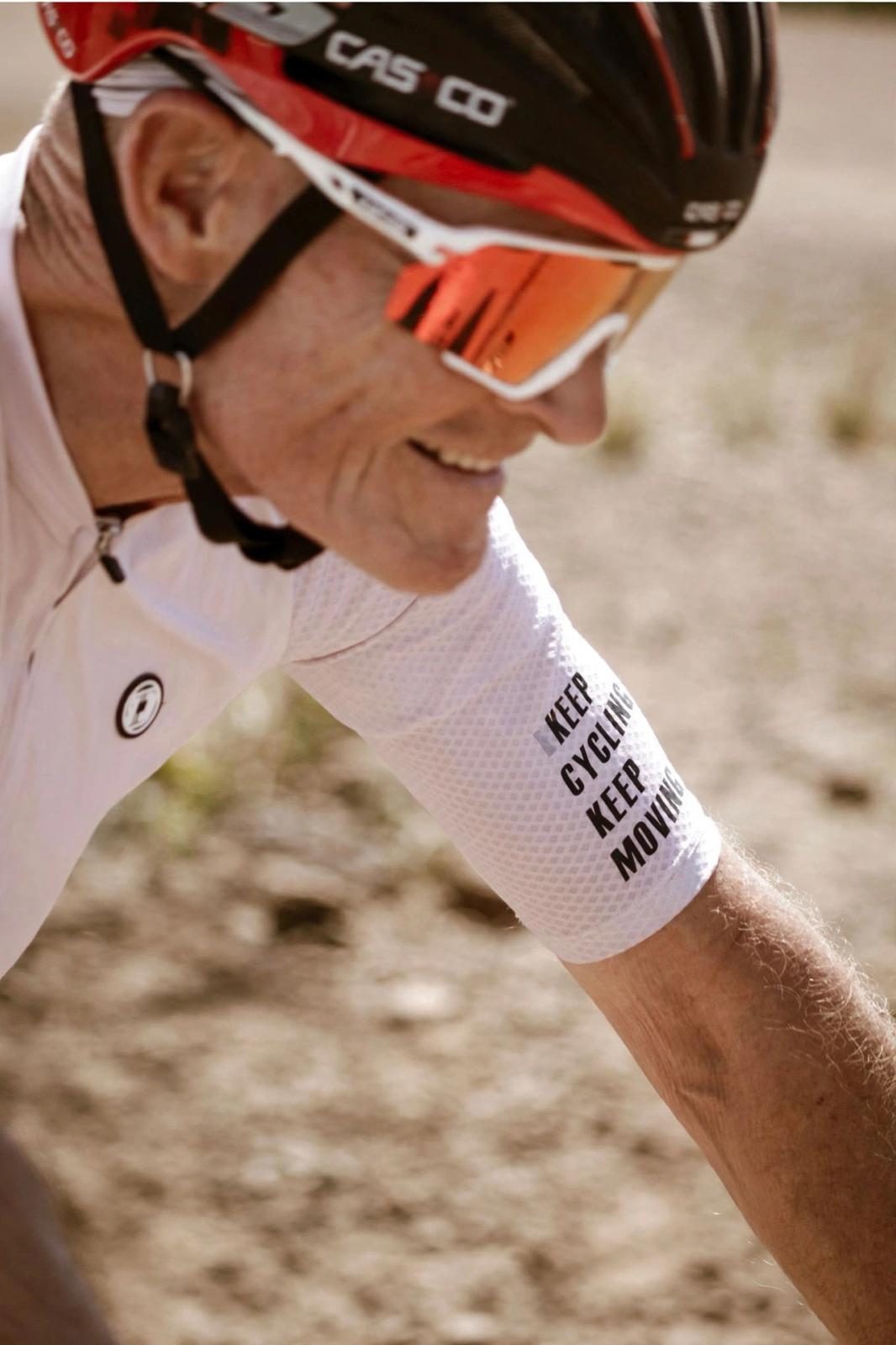
Michel is a fine example of what science describes. His motto sums it up perfectly: keep moving, keep riding.
Sources
- World Health Organization. Physical activity fact sheet, 26 June 2024.
- World Health Organization. WHO guidelines on physical activity and sedentary behaviour, 2020. Overview of changes: Heliyon 2022, table 1.
- Sciensano. Amount and intensity of physical activity of older adults aged 65 years and above, Food Consumption Survey 2022-2023.
- Hamer M, Lavoie KL, Bacon SL. Taking up physical activity in later life and healthy ageing: the English Longitudinal Study of Ageing. British Journal of Sports Medicine 2014;48:239.
- Paluch AE et al. Daily steps and all-cause mortality: a meta-analysis of 15 international cohorts. Lancet Public Health 2022;7(3):e219-e228.
- Stensvold D et al. Effect of exercise training for five years on all cause mortality in older adults: the Generation 100 study. BMJ 2020;371:m3485. Study protocol, BMJ Open 2015.
- Pahor M et al. Effect of structured physical activity on prevention of major mobility disability in older adults: the LIFE Study. JAMA 2014. See also the LIFE overview.
- Sherrington C et al. Exercise for preventing falls in older people living in the community. Cochrane Database of Systematic Reviews 2019, CD012424.
- Livingston G et al. Dementia prevention, intervention, and care: 2024 report of the Lancet standing Commission. The Lancet 2024;404:572-628. Summary: Dementia Australia.
- Pollock RD et al. and Duggal NA et al., Aging Cell 2018. Press releases: King's College London and University of Birmingham.
- Marijon E et al. Mortality of French participants in the Tour de France (1947-2012). European Heart Journal 2013;34(40):3145-50. Commentary: American College of Cardiology.
- Endurance sport activity and risk of atrial fibrillation: epidemiology, proposed mechanisms and management. Arrhythmia & Electrophysiology Review.
- American College of Cardiology. Atrial fibrillation in competitive athletes, 2019.
- Merghani A et al. Prevalence of subclinical coronary artery disease in masters endurance athletes with a low atherosclerotic risk profile. Circulation 2017;136(2).
- Stapleton JM et al. Aging impairs heat loss, but when does it matter? Journal of Applied Physiology.
- Kenny GP et al. Heat balance and cumulative heat storage during exercise performed in the heat in physically active younger and middle-aged men. European Journal of Applied Physiology 2010.
- Age-related decrements in heat dissipation in dry and humid heat. Journal of Applied Physiology 2014.
- European Society of Cardiology. 2020 ESC Guidelines on sports cardiology and exercise in patients with cardiovascular disease. European Heart Journal 2021;42:17-96. Summary: EMJ.